
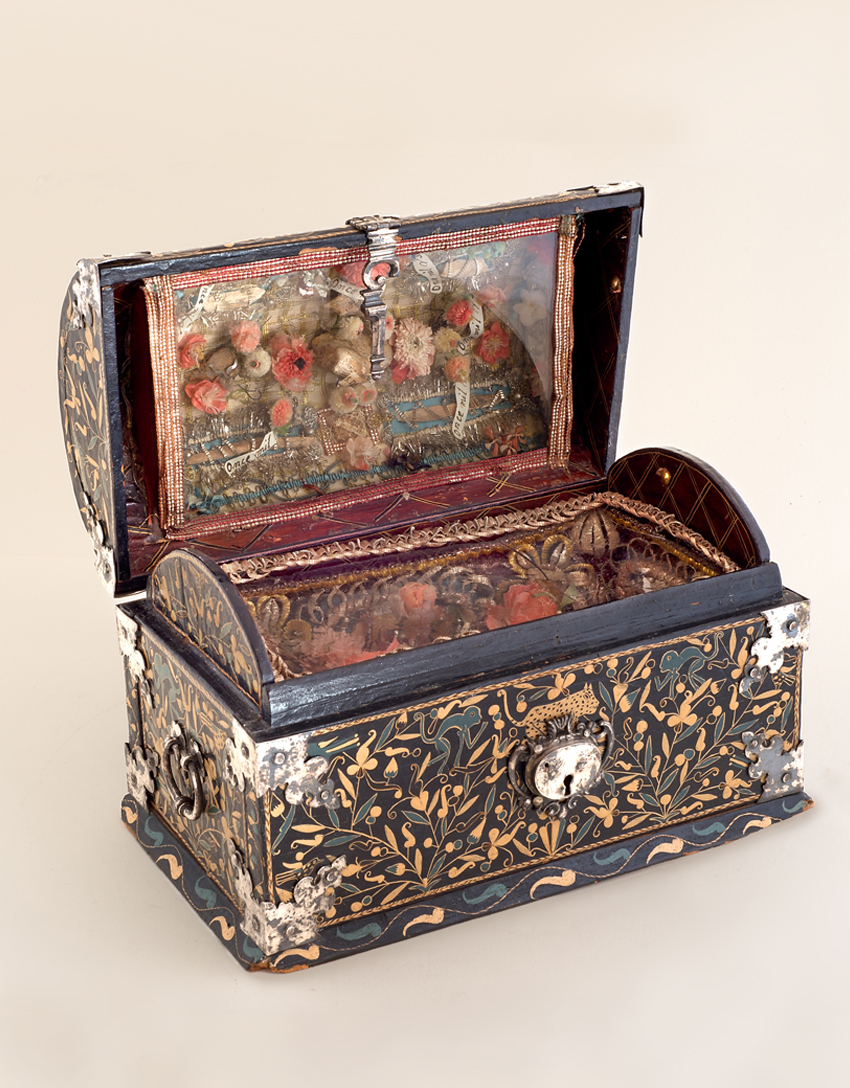
Reliquary chest of barniz de Pasto from the Museo Nacional de Artes Decorativas, Madrid. Analysis and tentative dating
Article Sidebar
Main Article Content
Abstract
In this paper, we analyze a unique chest that was transformed into a reliquary, made with barniz de Pasto and preserved in the Museo Nacional de Artes Decorativas in Madrid. In recent years, scientific and academic studies on barniz de Pasto have been increasing, and this study contributes to a deeper understanding of this art during the Peruvian viceregal period. A detailed analysis of the barniz de Pasto work and the reliquary's embellishments leads us to consider that the chest belongs to the early stage of the application of mopa-mopa film, tentatively dating to the first half or mid 17th century, and that its transformation into a reliquary was likely carried out in Seville in the 18th century.
Downloads
Article Details

This work is licensed under a Creative Commons Attribution-NonCommercial-NoDerivatives 4.0 International License.
Authors who publish in this journal accept the following conditions:
•Authors retain copyright and assign the right of first publication to the journal, with the article registered under the Creative Commons attribution licence, which allows third parties to use the published material provided that they mention the authorship of the work and its publication in this journal.
•Authors may make other independent and additional contractual agreements for non-exclusive distribution of the preprint (the version submitted to the editor), the postprint (the version after peer review) and the version of the article published in this journal (e.g., to include it in an institutional repository or publish it in a book), provided that they clearly indicate that the work was first published in this journal. Authors are permitted and recommended to disseminate their work on the internet (for example, in institutional online archives or on their websites) after publication in Además de; this can produce interesting exchanges and increase citations of the published work (see The Effect of Open Access).
References
ÁLVAREZ-WHITE, M. C., COHEN, D. y FERNÁNDEZ, M. O., “The Splendour of Glitter: Silver Leaf in barniz de Pasto Objects”, Heritage, núm. 6 (10), 2023, pp. 6581-6595 [https://doi.org/10.3390/heritage6100344].
BONIALIAN, M., La América española: entre el Pacífico y el Atlántico. Globalización mercantil y economía política, 1580-1840, Ciudad de México, El Colegio de México, 2019.
BONIALIAN, M., “El Perú virreinal transpacífico, 1580-1604. Agentes, plata y productos chinos entre Potosí, Lima, Nueva España, Filipinas y Macao”, Historia, núm. 55, 2022, pp. 43-81 [http://dx.doi.org/10.4067/S0717-71942022000100043].
CODDING, M., “The Decorative Arts in Latin America, 1492-1820”, en RISHEL, J. J. y STRATTONPRUITT, S., The Arts in Latin America. 1492-1820, Philadelphia, Philadelphia Museum of Art, 2006, pp. 98-113.
CODDING, M., “The Lacquer Arts of Latin América”, en CARR, D., Made in the Americas. The New World Discorvers Asia, Boston, Museum of Fine Arts Boston, 2015, pp. 74-89 [https://doi.org/10.3390/heritage7080204].
CODDING, M., “Methods for Dating the First Spanish American Lacquerwares: SeventeenthCentury Barniz de Pasto and Peribán Lacquer”, Heritage, 7 (8), 2024, pp. 4323-4353.
CREIXELL CABEZA, R. M., “Entre el viejo y el nuevo mundo: el escritorio de barniz de pasto de la colección de artes decorativas de The Hispanic Society of America”, Res Mobilis, núm. 3, 2014, pp. 119-131 [https://www.unioviedo.es/reunido/index.php/RM/article/view/10064/9868].
EZQUERRA DE BAYO, J. (dir.), Arte Español. Revista de la Sociedad Española de Amigos del Arte, tomo XIII, 1941, p. 22.
FRIEDEMANN, N. S., “El barniz de Pasto: arte y rito milenario”, Lámpara, vol. XXIII, núm. 96, 1985, pp. 15-24.
FRIEDEMANN, N. S., “El mopa-mopa o barniz de Pasto. Los marcos de la iglesia bogotana de Egipto”, en BANCO DE LA REPÚBLICA, Lecciones Barrocas: pinturas sobre la vida de la Virgen de la Ermita de Egipto, Bogotá, Departamento Editorial del Banco de la República, 1990, pp. 40-53.
GARCÍA MAHÍQUES, R., “Retablo de San Estanislao de Kostka en San Luis de los franceses de Sevilla”, Archivo Español de Arte, vol. 93, núm. 371, pp. 239-258 [https://doi.org/10.3989/aearte.2020.16].
GÓMEZJURADO GARZÓN, A. J., “Mopa-mopa o barniz de pasto, comercialización indígena en el periodo colonial”, Estudios latinoamericanos, núm. 22-23, 2008, pp. 82-93.
GRANDA PAZ, O., Aproximaciones al barniz de Pasto, Barranquilla, Editorial Travesías, 2007.
INSUASTY, B., ARGOTI, J. C., ALTAREJOS, J., CUENCA G. y CHAMORRO, E., “Caracterización fisicoquímica preliminar de la resina del mopa-mopa (Elaeagia pastoensis Mora), barniz de Pasto”, Scientia et Techinica, vol XIII, núm. 33, 2007, pp. 365-368.
IWASAKI CAUTI, F., Extremo Oriente y Perú en el siglo XVI, Madrid, Mapfre, 1992.
KAWAMURA, Y. (com.), Lacas Namban. Huellas de Japón en España. IV Centenario de la Embajada Keichô, Madrid, Ministerio de Educación, Cultura y Deporte, Fundación Japón, 2013.
KAWAMURA, Y., “Influencias que deja la laca Namban en las artes de la América virreinal”, en KAWAMURA, Y., ANCHA, A. y BALDUZ, B., Laca Namban. Brillo de Japón en Navarra, Pamplona, Gobierno de Navarra, 2016, pp. 53-59.
KAWAMURA, Y., “Manila, ciudad española y centro de fusión. Un estudio a través del inventario del gobernador de Filipinas Alonso Fajardo de Tenza (1624)”, E-Spania. Quelle histoire globale au XVIe siècle ? / Fronteras de Ultramar, 30, 2018, pp. 1-13 [https://journals.openedition.org/e-spania/27950].
KAWAMURA, Y., “The Art of Barniz de Pasto and Its Appropriation of Other Cultures. Arte del barniz de Pasto y las apropiaciones de otras culturas”, Heritage, núm., 6 (3), 2023, pp. 3292-3306 [https://doi.org/10.3390/heritage6030174].
LATASA VASALLO, P. y FARIÑAS DE ALBA, M., “El comercio triangular entre Filipinas, México y Perú a comienzos del siglo XVII”, Historia Naval, núm. 35, 1991, pp. 13-28.
LÓPEZ PÉREZ, M. P., En torno al estrado. Cajas de uso cotidiano en Santafé de Bogotá, siglos XVI a XVIII, Bogotá, Museo Nacional de Colombia, 1996.
LÓPEZ PÉREZ, M. P., “El Barniz de Pasto. Encuentro entre tradiciones locales y foráneas que han dado la identidad a la región andina del sur de Colombia”, en CABELLO CARRO, P., Patrimonio Cultural e Identidad, Madrid, Ministerio de Cultura, 2007, pp. 225-234.
LÓPEZ PÉREZ, M. P., “Quito, entre lo prehispánico y lo colonial. El arte del barniz de Pasto”, en ORTIZ CRESPO, A. y PACHECO BUSTILLOS, A., Arte quiteño. Más allá de Quito, Quito, FONSAL, 2010, pp. 45-63.
LÓPEZ PÉREZ, M. P., “Reflections on the Forms and Arrangements of Surface Images in the Art of Barniz de Pasto, from the 16th to the 19th Century”, Heritage, núm. 6 (7), 2023, pp. 5424-5441 [https://doi.org/10.3390/heritage6070286].
MORGA, A., y HIDALGO NUCHERA, P., Sucesos de las Islas Filipinas, Madrid, Polifemo, 1997.
NEWMAN, R. y DERRICK, M., “Painted Qero Cups from the Inka and Colonial Periods in Peru: An Analytical Study of Pigments and Media”, en Materials Issues in Art and Archaeology VI: Symposium Held November 26-30, 2001, Boston, Warrendale, Materials Research Society, 2002, pp. 291-302.
NEWMAN, R., KAPLAN, E. y ÁLVAREZ-WHITE, M. C., “The Story of Elaeagia Resin (Mopa-Mopa), So far”, Heritage, 6 (5), 2023, pp. 4320-4344 [https://doi.org/10.3390/heritage6050229].
NEWMAN, R., KAPLAN, E. y DERRICK, M., “Mopa Mopa: Scientific Analysis and History of an Unusual South American Resin Used by the Inka and Artisans in Pasto, Colombia”, Journal of the American Institute for Conservation, núm. 54, 2015, pp. 123-148 [DOI: 10.1179/1945233015Y.0000000005].
RIVAS PÉREZ, J. F., “Domestic Display in the Spanish Overseas Territories”, en ASTE, R., Behind Closed Doors. Art in the Spanish American Home, 1492-1898, Nueva York, Brooklyn Museum, 2014, pp. 49-103.
ROMERO DE TERREROS, M., “Relación del Japón (1609), por Rodrigo de Vivero y Velasco. Introducción y notas”, Anales del Museo Nacional de México, 1, 1934, pp. 67-111.
TORO, F., MINA-HERNÁNDEZ, J. H. y BOLAÑOS, C. A., “Physico- Mechanical and Thermal Studied of Mopa-Mopa Natural Resin Conditioned at Different Relative Humidities”, Biotecnología en el Sector Agropecuario y Agroindustiral, vol. 11, núm. 1, 2013, pp. 30-36.
ZABÍA, A., “New Contributions Regarding the Barniz de Pasto Collection at the Museo de América, Madrid”, Heritage, 7 (2), 2024, pp. 667-682 [https://doi.org/10.3390/heritage7020033].